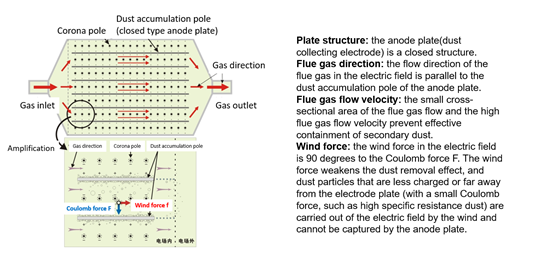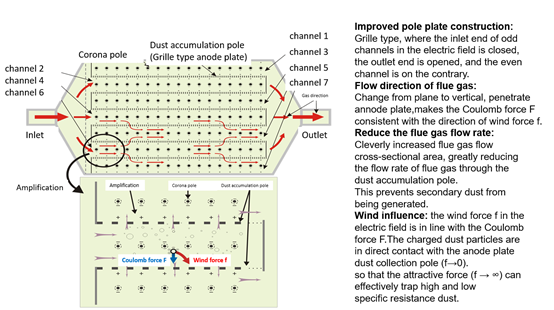
Basic Principles of the Coulomb Electric Field in ESP
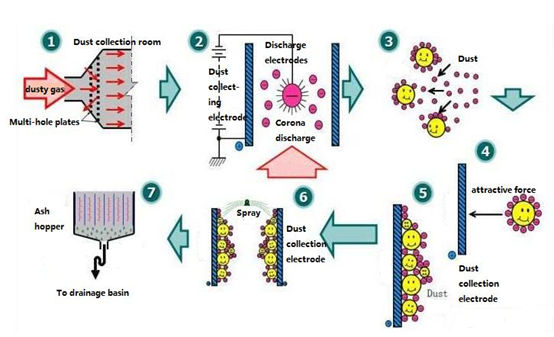
The process of removing suspended dust particles from a gas through electric dedusting involves four complex and interrelated physical processes:
- Ionization of Gases: This process involves converting neutral gas molecules into charged ions.
- Charging of Suspended Dust Particles: Dust particles in the gas become charged through interactions with the ionized gases.
- Movement of Charged Dust Particles Towards the Electrodes: The charged dust particles are propelled towards the electrodes due to the Coulomb forces acting on them.
- Deposition of Charged Dust Particles on the Electrodes: Once they reach the electrodes, the charged dust particles are collected and deposited there.
Principle of the Coulomb Electrostatic Precipitator
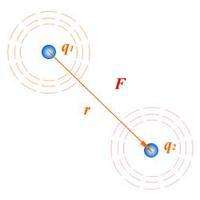
Electrostatic precipitation technology is derived from Coulomb’s Law, the basic theory of electrostatics,

F: Coulombic force, i.e. the attractive force between the charged dust particles and the dust accumulation pole of the anode plate.
r: distance between the charged dust particle and the dust accumulation pole of the anode plate.
k: electrostatic force constant.
q1, q2: amount of dust charge, amount of dust accumulation pole (anode plate) charge.
The magnitude of the Coulom bforce is inversely proportional to the square of the distance rbetween the two point charges,and is proportional to the product of the charge amounts.
Process flow of conventional ESP
Process flow of the Coulomb ESP